9 minutes reading
2025.02.10

When No-Go Is the Only Option: Independent Testing and Critical IT Decision Support for Banks

Short overview of the project 

Client Profile

member of a large international banking group 

Industry

financial sector, banking services, with an exceptionally strict regulatory environment and high quality expectations

Company location

Budapest, Hungary

Company Size

several thousand employees, with a complex organisational structure

Client Request

IDM access management system functional testing from planning through coordination to execution, with full responsibility assumed.

Experts involved in the project on TestIT’s side

  • 1 test coordinator
  • 6 manual testers
  • 1 test automation engineer

Special challenges

  • background of the rollout
  • incomplete documentation
  • complex system integration
  • strict compliance requirements

Technologies and tools used

  • Jira – a test management and ticketing system for defect tracking and task management
  • SoapUI – API testing tool for integration testing
  • Confluence – for documentation and knowledge sharing
  • special test management plugins (e.g. Xray or Zephyr for Jira)
  • SQL knowledge – for database queries

Required expertise and soft skills

  • in-depth knowledge of banking processes
  • functional testing expertise
  • test management experience
  • database knowledge
  • systems thinking
  • proactive communication
  • problem-solving skills
  • precision
  • ability to cooperate
  • stakeholder management

We brought an end to a project that had been running for years

At our client, a banking group, the rollout of a mission-critical banking system had been ongoing for years. The bank’s management recognised that they needed an independent, professional partner who could objectively assess the state of the system and take full responsibility for functional testing from planning through coordination to execution. Based on our previous successful cooperation, they chose TestIT. The goal was clear: the system should only go live once it truly met the business expectations and operated reliably.

TestIT’s approach: independence, methodology and proactive communication

When we join a project of this kind, the very first and most important step is to build trust and to establish a clear, transparent framework.

TestIT’s approach rests on three pillars: independent expertise, thorough methodology and continuous, proactive communication.

1. Independent expertise and objective assessment

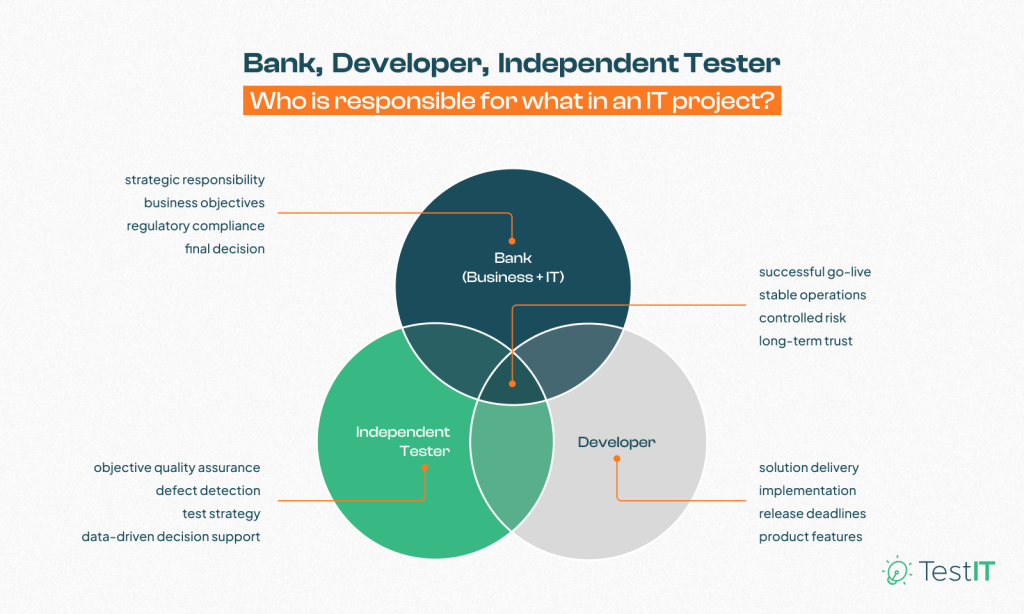
One of our company’s greatest strengths is that we are completely independent from the software vendor and the internal development teams. This allows us to evaluate the state of the system objectively and without bias. We have no interest in a rushed go-live; our only goal is quality and the minimisation of risks. This independence gives IT decision-makers confidence that the information they receive is accurate and reliable.

2. Thorough methodology

We started the project by establishing a solid methodology and then defining the first steps of high-quality testing:

1. We gathered information and consolidated existing knowledge.
2. We cleaned up the processes and developed the testing strategy.
3. We selected the appropriate testing procedures and tools.
4. We designed detailed test cases.
5. We performed structured testing and reported defects."

3. The power of continuous communication: transparency and decision support

In a complex project, communication is of critical importance. At TestIT we believe that continuous, transparent dialogue is essential for successful project management and effective risk handling. In this project, our continuous communication rested on the following pillars:

  • regular status meetings
  • proactive risk management
  • data-driven reports
  • stakeholder management
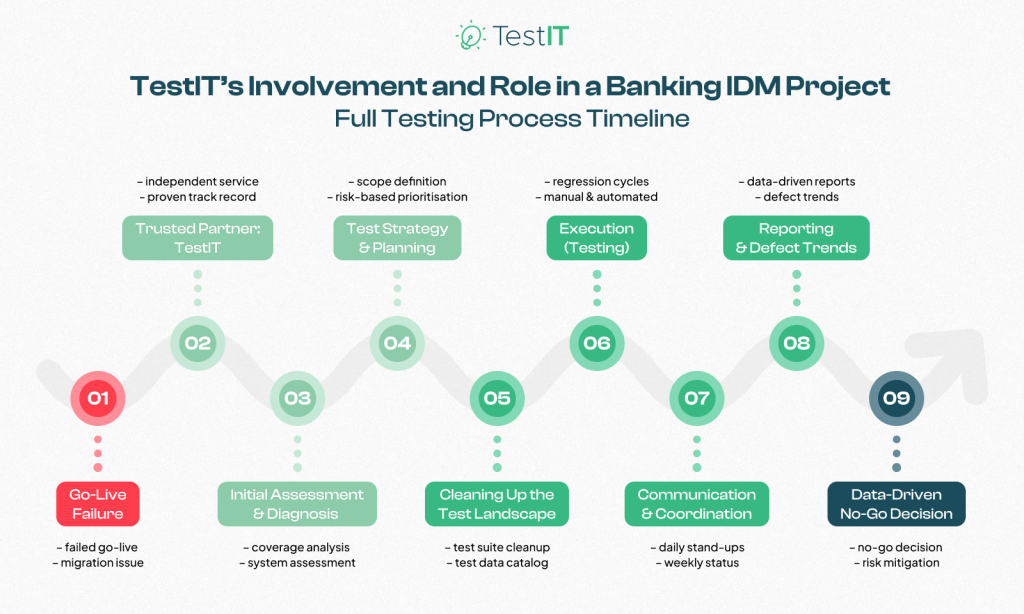
Full banking IDM testing process timeline with TestIT’s role illustrated in nine steps

How did we solve the project’s biggest challenges?

During the project we faced a number of major challenges that required not only specialised expertise but also flexibility. Below we present the most important ones and the solutions we applied.

1. Difficulties caused by the project history

Since we took over an already ongoing rollout, one of the most important foundations of the cooperation was to build professional trust towards TestIT. Our goal was not only to find defects, but first of all to obtain a reliable picture of the system’s actual state and to convey this to our client.

The TestIT solution

✔ We prepared objective, data-driven reports. Transparent defect reporting and continuous communication helped ensure that the decision-makers got a real picture and made their decisions based not on hopes but on facts. Here, TestIT’s independent position was a key factor.

2. Updating the documentation

In the banking sector, even the smallest discrepancy in documentation can have serious consequences. The systems themselves have extremely complex business logic, with numerous specific banking products and processes. User manuals and system documentation always need to reflect the current state of the system. Updating them and uncovering any gaps is crucial, as only then can the actual testing work begin.

The TestIT solution

✔ Proactive information gathering – Our testers were not satisfied with the available documentation. We organised regular workshops with business analysts and key users to uncover the real business processes and requirements.

✔ Banking domain knowledge – Members of our team had deep knowledge of banking processes, which enabled them to quickly understand the complex business logic and to ask relevant questions.

✔ System exploration and reverse engineering – Where documentation was missing, we examined the system itself and tried to map the underlying logic based on its functionality.

✔ Development of detailed test cases – Based on the information gathered, we created detailed, step-by-step test cases that covered critical business processes, exceptions and boundary conditions. We paid particular attention to negative test cases.

3. Long project cycle and changing requirements

The years-long rollout also meant that requirements could change during the project: new functions might be added, or the regulatory environment could be modified. For the testing strategy, this required continuous adaptation.

The TestIT solution

✔ Introducing agile elements – Although the project basically followed a typical large-enterprise waterfall framework, we tried to introduce agile elements into the testing process. This included short, iterative testing cycles, continuous feedback and flexible resource management.

✔ Prioritisation and focus – We continuously prioritised test cases based on business value and risk, ensuring that the most critical functions received the most attention.

✔ Version control and configuration management – We worked in close cooperation with the development team on version control and configuration management to ensure we always tested the correct system version.

4. Complex system integration

The banking system communicated with many external and internal systems, which required extremely complex integration testing. In addition, due to the importance of financial data accuracy, database checks were also of key importance.

The TestIT solution

✔  Integration testing strategy – We developed a detailed integration testing strategy that covered data transfer and functionality between the various systems.

✔ Database knowledge – Our testers had SQL skills, enabling them to directly verify the accuracy and integrity of the data stored in the database. This was critical to ensuring the correctness of financial transactions and reports.

✔ Close cooperation with developers – We continuously coordinated with the developers regarding integration points and potential defects, which accelerated the defect-fixing process.
The project in numbers

Number of regression test cases

1,204

Number of executed regression cycles

8 cycles

Duration of one regression cycle

10 working days (with 4 testers)

Number of logged defect tickets

287

Learnings

The lessons learned are relevant not only in the banking sector but in any complex IT project for IT decision-makers:

A “No-Go” is not a failure but a responsible decision. It is important to emphasise that avoiding an unsuccessful go-live is in fact a huge success. In the long run it protects the company from much greater damage than the delay caused by extending the project. IT decision-makers must be brave enough to make these difficult decisions when the data supports them.

Testing cannot be left to the end of the project. Early involvement is of critical importance.

Lack of documentation must not become a blocker. An experienced testing team is able to proactively uncover information, systematise processes and test effectively even under unfavourable conditions.

Continuous, transparent communication is indispensable. Regular status meetings, proactive risk management and data-driven reports ensure that all stakeholders have up-to-date information and that decisions are based on consensus.

Independent expertise is invaluable. A neutral external view is needed, one that has no interest in a rushed go-live and is able to present the true state of the system. At the same time, this independence gives IT leaders the confidence to make well-founded decisions, even when those decisions are difficult.

If you want to be sure of your IT project’s success...

If you are preparing for a complex system implementation, a legacy system migration, or you simply want to be certain about the execution of an IT project, with TestIT we offer you the following based on our many years of experience:

Comprehensive testing services – From planning and coordination to execution, whether it’s functional, performance or automated testing.

✔ Expert knowledge for the most complex systems – Especially in the financial sector, where domain knowledge is critical.

✔ Independent, objective assessment – We have no interest in a quick go-live; our only aim is quality.

✔ Proactive communication and transparency – We continuously inform you about the project status and the risks identified.

✔ Flexible and scalable resources – Whether you need a full testing team or specific expertise.

FAQ

1. How can you realistically plan the duration of a large (1000+ test case) regression cycle?

A realistic plan requires more than a rough estimate. In the first few regression cycles execution is almost always slower because there are many fresh defects, more administration, and at the same time the test set and the environment are still evolving. Therefore, for the first 2–3 cycles it is worth calculating with longer lead times and refining the target duration (e.g. 10 working days) only based on actual experience. The real speed of regression always depends on defect trends, stability and the learning curve of the test team.

2. What can test management do when documentation is weak but testing cannot be postponed?

In such cases the test team also needs to take on a partial “documentation-replacement” role. It is advisable to hold quick, focused knowledge-sharing sessions with key stakeholders (developers, system analysts, business side), to “write” the processes into the test cases and to align test data design with real business operation. Test cases, defect tickets and the test data catalogue together practically become quasi-documentation – provided they are maintained consistently in a shared knowledge base.

3. When is a No-Go decision justified at the end of a long-running rollout?

A No-Go is professionally defensible when the test results consistently show that the system still carries a level of business risk that cannot be accepted: there are many critical and high-severity defects, the environment is unstable, regression defects keep recurring and critical business processes do not run reliably. In such a situation the decision should be based on test coverage, defect statistics and environment stability – even if the decision is financially and emotionally painful. In the long run, a well-supported No-Go causes far less damage than a risky go-live.

You may also be
interested in these!

Share your challenge

Work
with us!

Send us a message and let us know how we can help you, and our sales team will contact you as soon as possible to discuss the details!

We have an empty table that might be waiting for You! Fill in the form, tell us why You want to be the newest member of the TestIT team and let's get to know each other!

Contact Us Career
Adatvédelmi áttekintés

Ez a weboldal sütiket használ, hogy a lehető legjobb felhasználói élményt nyújthassuk. A cookie-k információit tárolja a böngészőjében, és olyan funkciókat lát el, mint a felismerés, amikor visszatér a weboldalunkra, és segítjük a csapatunkat abban, hogy megértsék, hogy a weboldal mely részei érdekesek és hasznosak.