English (UK)
 Magyar
 Deutsch
How and why did we move from T&M to Testing as a Service and then to a hybrid model in a banking lending project? A case study.
Table of Contents
Project background
Our collaboration with one of the leading regional banking groups is particularly valuable because, over the years, we have jointly developed an operating model that adapts to changing needs, is sustainable in the long term, and meets demanding QA requirements.
Traditional resource-based engagements under a Time and Materials model require significant internal management capacity from clients once the team reaches a certain size. In this contractual model, internal managers are responsible for day-to-day task allocation, recruitment, onboarding, and technical oversight. We sought a solution that would benefit both parties over the long term.
Below, we explain how we transformed quality assurance for the banking group’s retail lending project from a traditional T&M model into a service-based Testing as a Service (TaaS) model, and how we subsequently developed it into a hybrid operating model.
Project at a glance
| Industry | Banking, digital retail lending |
| Geographic reach | Regional enterprise operating in multiple countries |
| Company Size | 10,000+ employees |
| Client requirements | Quality assurance for a workflow-based lending application across domestic and international projects. The objective was to validate a central framework that enables customers to apply for retail loans quickly via the web and mobile devices (Android and iOS). |
| TestIT specialists assigned to the project | Dedicated team of 8–11, including:
|
| Tasks completed by the TestIT team - quarterly averages |
|
| Technologies and tools used |
|
| Specific challenges |
|
| Required expertise and soft skills |
|
When T&M is no longer enough, TaaS steps in
As part of the bank’s agile transformation, product- and domain-focused organizational units known as tribes were established. TestIT joined the tribe responsible for retail lending processes.
The project aimed to extend the lending framework developed for the domestic market to foreign subsidiaries, adapting it to local regulations and market conditions in each country. At this stage, testing was limited to SST (System Standalone Test): functional validation at component level in a non-integrated environment.
Our collaboration began under a traditional T&M arrangement, with a focus on test automation. Our colleagues started building the automation framework, but as the project progressed, new needs emerged: manual testers and test management capacity were also required. As testing activities expanded, the client sought a scalable solution for recurring tasks that could be clearly formalized, as well as a more efficient operating model. Could testing capacity be scaled quickly and flexibly, and could we assume greater operational responsibility? At the same time, we were looking for a service-based alternative between T&M and a fixed-project approach.
We therefore proposed introducing the Testing as a Service (TaaS) model. We developed TestIT’s latest service based on years of experience in QA projects and current market needs, convinced that it offers a good solution for both parties in this type of collaboration.
Our approach: transitioning to TaaS
Before we could begin delivering services under the new model, we first had to define the conditions needed for TaaS to work effectively in this project. We made the following commitments:
- We would create the necessary internal knowledge resources.
- We would manage the onboarding processes.
- We would take responsibility for allocating and scheduling tasks within our team.
- We would provide transparent billing based on a pay-per-use model.
This immediately relieved the client’s internal managers of the day-to-day task allocation and micromanagement burden typically associated with T&M. Our only request was that we be able to make the technical decisions in line with the agreed deadlines and objectives.
We soon moved from the initial test-case-based billing to a more precise test-step-based model, which reflected the volume of work more accurately. The TaaS model has now been operating successfully for several years.
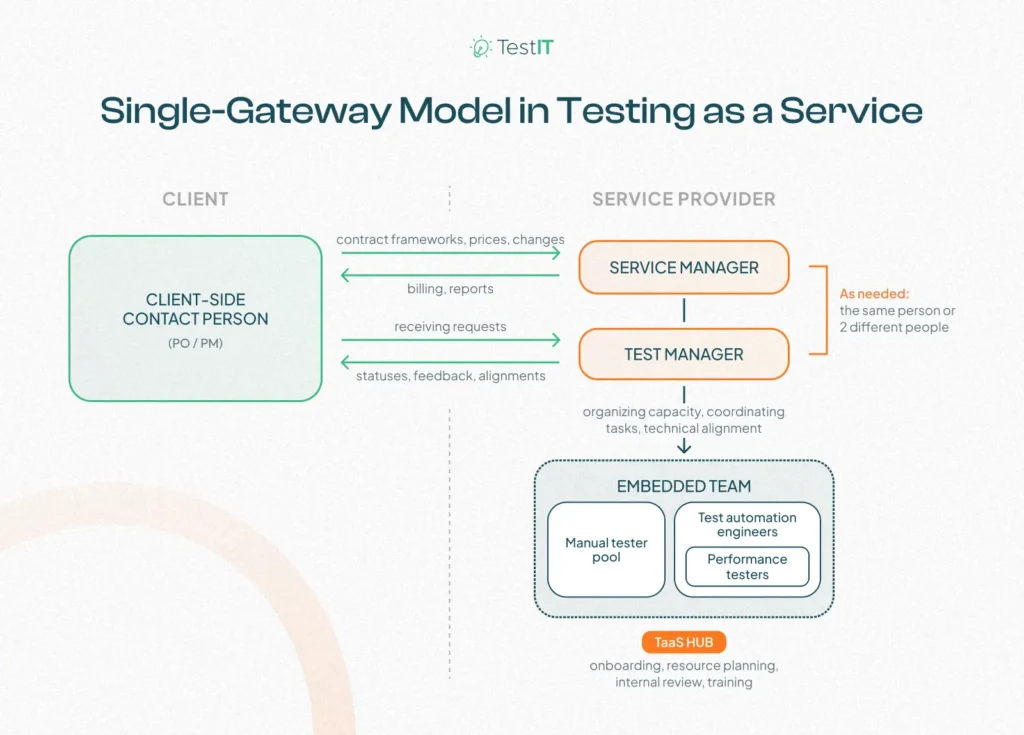
Why did this service-based model work well in practice?
1. Flexible scalability
The single point of contact model, in which the test manager receives all requests, meant that the client only needed to liaise with one person. When testing demand suddenly increased—for example, at the start of a country-specific implementation—we could reallocate internal capacity across mobile and framework projects already running in parallel for other countries, avoiding recruitment lead times.
2. Organizational stability
The model successfully withstood several internal organizational and management changes on the client side. Because service delivery depended on well-documented processes rather than specific individuals, continuity was maintained throughout.
3. Efficient execution of formalized, recurring tasks
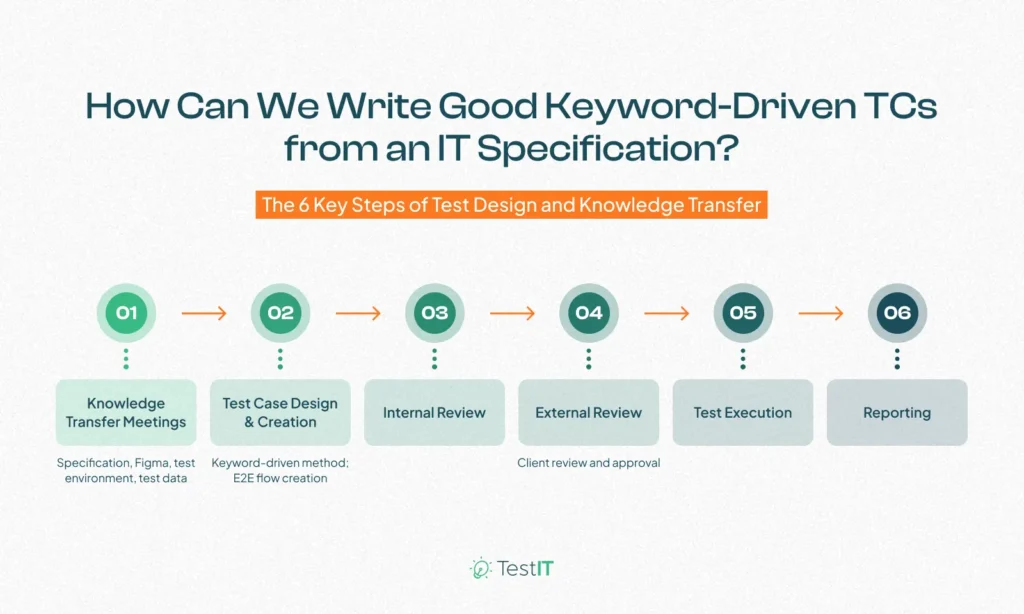
Documentation produced by the bank and support from its systems analysts enabled testers to write test cases efficiently without lengthy consultations or workshops. In addition, the automation framework provided by TestIT made it possible to translate keyword-based test cases into automated tests quickly and efficiently, while also simplifying maintenance.
4. Shared knowledge retention
The pool-based operating model and consistent keyword-driven methodology enabled testers to stand in for one another seamlessly, eliminating the risk of dependence on individual team members.
The emergence of the hybrid model: Testing as a Service and T&M combined
Over time, however, the project also revealed the limitations of a purely task-based TaaS model.
- Although our standalone testing (SST) worked well, connecting the components - the frontend, scoring engine and local systems - revealed additional defects outside the original SST scope.
- A need also arose to include integration testing and user acceptance testing (UAT) support.
- The fixed squad structure established at the start of the project could not always accommodate the uncertainty and frequent scope changes associated with new projects.
- Where documentation was incomplete, additional specialist expertise was also needed. The quickest way to provide it was to bring in new team members on the spot.
Our shared commitment to professional quality assurance encouraged both our client and us to take the existing collaboration to the next level: a model that would retain the benefits and structure of TaaS without losing the flexibility that had characterized the initial service.
Under the new model, our colleagues supported the client’s staff on the front line within a T&M arrangement. They worked closely with business analysts and systems analysts to investigate and clarify how the solution worked. We assigned established, repeatable processes that could be standardized, such as regression testing, to the task-based side, where we could execute and automate them with high efficiency.
Three testing models: T&M, Testing as a Service and the hybrid model
| Operational area | Time and Materials | Testing as a Service (TaaS) | Hybrid model |
| Resource management |
|
|
|
| Day-to-day management |
|
|
|
| Knowledge retention |
|
|
|
| Commercial model |
|
|
|
How we responded to prevent future incidents
During the collaboration, we addressed several critical incidents, including a production crash after which we expanded the regression test suite. To help prevent future performance testing issues, we introduced a Performance Readiness Checklist. We made manual validation mandatory alongside automated measurements and introduced a dedicated performance ticketing system to help identify and resolve uncertainties.
Our shared results: reduced management burden, flexible scaling and successful rollouts
The client’s outstanding expertise and flexibility played a major role in the success of our collaboration. Our client consistently supported joint problem-solving as a partner, providing constructive feedback. This supportive and open approach enabled us to respond to feedback and make quick adjustments, directly contributing to the success of the hybrid model and the continuous improvement of our processes.
What we are proud of:
 Successful international rollout
Stable versions of the application have been successfully deployed in the other countries, and preparations are currently under way to support the banking group’s further geographic expansion.
Validated performance measurements We obtained reliable measurements that matched the response times recorded by the external vendor.
Elimination of the internal management burden The 11-person testing team is managed, recruited and professionally supervised without intervention from the client’s internal management.
Flexible capacity management We successfully responded to fluctuations in the project’s resource needs, making internal staffing changes and expanding the team without disrupting the client’s day-to-day operations.
What did we learn from this project?
Like every project we undertake, this one added significantly to TestIT’s knowledge. A flexible, solution-oriented approach, combined with our expertise, ultimately delivered a result that satisfied everyone. This led to a successful, long-term partnership.
What lessons can others take away for similar projects?
1. Flexible adaptation of the testing model is essential.
No single theoretical model works unchanged throughout the entire lifecycle of a complex project. Teams must be ready to supplement rigid service structures with hybrid elements when needed, such as separating front-line work from task-based delivery.
2. Feedback and trust together create significant opportunities for improvement.
Client feedback must be fully incorporated into the way we work. Some of our quality assurance processes, such as the performance readiness process, were developed as a direct result of this feedback and led to more stable operations.
3. Testing is not merely a downstream activity.
In this project, we were able to work closely with the business and take a proactive approach focused on delivering a working solution.
How can TestIT help with similar testing projects?
Testing as a Service (TaaS) is a service model designed primarily for enterprise needs. Its purpose is to take over the day-to-day management of testers from our clients, deliver the results they need and make release cycles more predictable.
Our TaaS model is an optimal solution if:
- You want to free your internal IT managers from day-to-day operational micromanagement.
- You need to manage fluctuating resource demands, scaling up or down quickly without recruitment lead times.
- You want to reduce dependence on individuals through a documented, hub-based knowledge base that enables team members to stand in for one another.
FAQ
1. What should Testing as a Service billing be based on in practice?
In our experience, it is worth moving from initial test-case-based billing to test-step-based billing. The number and complexity of test steps provide a much more accurate picture of the actual volume of work completed, making billing transparent and verifiable for both parties.
2. How can fluctuations in testing capacity be managed across different release cycles?
Our TaaS model enables dynamic reallocation of resources. Because our team members follow a consistent methodology, our delivery organization can shift capacity between parallel workstreams - mobile, framework and local implementations - to wherever the release deadline is most pressing. This helps prevent internal teams from becoming overloaded or resources from being underutilized.
3. How can uncertainty involving external vendors and test environments be managed during performance testing?
One of the most common performance testing mistakes is to start measurements before backend systems or the external partner’s tools are properly prepared. To address this, TestIT developed a rigorous Performance Readiness Checklist. A test run can only begin once all prerequisites and environmental parameters have been verified. Automated results are supported by manual validation and dedicated defect tracking.