English (UK)
  Magyar
  Deutsch
 The Biggest Challenge for Enterprise IT Leaders in 2026 is AI
In recent years, generative and agentic AI solutions have become increasingly deeply embedded in the operations of large enterprises. The emergence of AI-based technologies is forcing not only strategic but also cultural shifts in the way companies operate.
For IT leaders, it is no longer enough to simply keep pace with this change; they must be able to think ahead. The real question is no longer whether to introduce AI, but how to do it well, intelligently, and in a way that aligns with the company’s core values. Below, we offer some practical guidance to help navigate this challenge.
Current Situation: IT Leaders Often Navigate the Unknown
At a modern large enterprise, introducing AI is far from a simple task. The technology itself is complex, changes are happening rapidly, and in some cases the necessary expertise is still lacking. According to a recent survey:
- 97% of software testing teams already use agentic AI or plan to introduce it in the near future, while at the same time
- 61% of leaders admit that they do not really understand how to test software effectively with AI
Under these circumstances, it is difficult to make responsible decisions without fully understanding the depth and implications of the technology.
What Can Go Wrong? Pitfalls of Rapid AI Adoption
Lack of Trust in AI
If users - or even executives - do not trust the technology, the entire implementation can fail. While 72% of respondents believe that agentic AI will be able to conduct testing fully autonomously by 2027, the same proportion feel uncomfortable granting AI agents full access to their data. This trust gap is a major obstacle, especially in large enterprises where data protection, regulatory compliance, and safeguarding corporate reputation are fundamental requirements.
Questions of Responsibility When Using AI
In the survey mentioned earlier, most respondents (85%) identified hybrid operation as the ideal model when asked how much responsibility can be delegated to AI. AI, of course, does not replace humans; it complements them. However, when agentic AI makes mistakes, 60% of organizations still tend to blame people rather than the technology. This makes it essential to establish clear accountability frameworks in the long term.
Data Leakage, Hallucinations, and Serious Risks
Generative AI models process vast amounts of data, and their inner workings are often opaque. This creates the risk of data leakage as well as so-called “hallucinations” (the generation of false or non-existent information). In heavily regulated industries such as finance or healthcare, companies therefore proceed much more cautiously. Successful AI adoption requires thorough planning, robust security protocols, and strict data governance rules.
What Should We Pay Attention to When Introducing AI-Based Technologies in Large Enterprises?
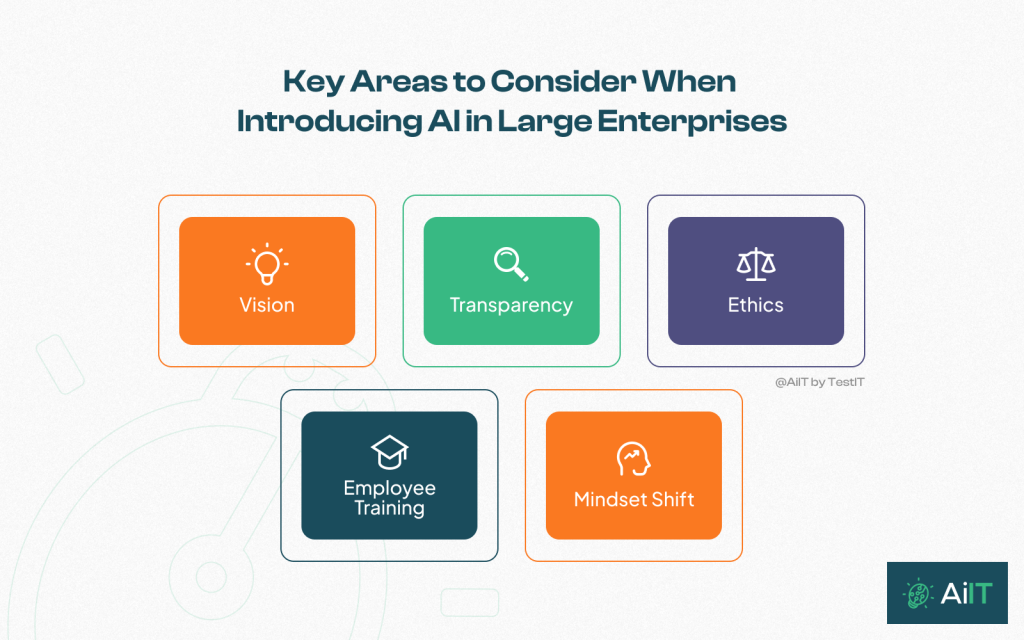
A clear vision is essential.
It is crucial to articulate how AI supports the company’s strategic objectives and what concrete business value it creates. This cannot be achieved without long-term planning and commitment. The roadmap must be realistic and aligned with the organization’s level o maturity, available resources, and potential risks.
AI systems must operate transparently and ethically.
This is essential both for societal acceptance and long-term success. It includes responsible data handling, minimizingalgorithmic bias, and applying Explainable AI (XAI) principles so that decisions can be understood by all stakeholders. In the longrun, this also requires a clear leadership model and well-defined governance around the autonomy of AI agents.
Training colleagues and transforming corporate culture are non-negotiable.
Building AI literacy, understanding ethical considerations, and fostering cross-team collaboration and a strong quality mindset are all indispensable for successful adoption.
This is more than a technological transition.
Integrating AI into large enterprise IT projects reshapes existing tasks and areas of responsibility from the ground up. Just consider the emergence of the “Shift Everywhere” mindset, the convergence of DevOps and AI, or the transformation of QA roles. All of this requires a fundamental change in perspective and a rethinking of established practices—but the potential unlocked by this shift is enormous.
Why Is an External Partner Needed for AI Adoption?
All of the above represent demanding, resource-intensive challenges that go beyond the traditional boundaries of IT expertise. By selecting the right partner, organizations can navigate the transition more safely and significantly reduce the risk of failure.
Some Advice for IT Leaders Before Starting an AI Transformation:
- Choose external partners with deep IT systems knowledge and proven AI expertise.
- Make sure your partner has hands-on experience with introducing new technologies and a strong understanding of large enterprise environments and culture.
- Look for a strategic, end-to-end project management approach that covers the entire lifecycle.
- Avoid one-size-fits-all or “boxed” solutions; instead, work with partners who can take your existing infrastructure and business objectives into account.
As an external, independent expert partner, TestIT brings together all of its accumulated experience in this role. With customized solutions, up-to-date AI expertise and many years of industry experience in enterprise IT implementation and testing, we guide our partners through this transformation with a comprehensive, strategic approach.
Discover how AI can support your business - get in touch with us today! !
Sources:
Testing Organizations' Widespread Adoption of Agentic AI, but Leadership Lags in Understanding
7 ways AI is changing software testing
Shift Everywhere in Software Testing: The Future with AI and DevOps