English (UK)
  Magyar
  Deutsch
 Complex billing and system integration changes are only safe with early testing. Lessons learned from an energy market project.
Table of Contents
Project at a Glance
Industry
Energy
Geographical location
Hungary
Company Size
1–50 employees
The Client’s Request:
- Testing of the implementation of a billing system
- Testing of synchronization between systems, invoice issuance
- Regression testing of the CRM system
- Testing of the new tariff structure
The Professionals Involved in the Project from TestIT
- 3 manual testers
- including 1 test coordinator
Technologies Applied
- SPIRA
- Jmeter
Required Expertise and Skills
- testing methodology,
- integration testing,
- financial/billing knowledge
- test administration,
- performance testing
- clear communication with business and IT stakeholders,
- system-level thinking across the full E2E process,
- precise and structured documentation (test cases, defects, statuses),
- the ability to manage changing priorities through calm, structured, and solution-oriented communication
Complex System Interfaces, Changing Business Rules, Tight Deadlines - Sound Familiar?
In complex corporate environments, testing is still often regarded merely as a necessary but fundamentally control-oriented function: something that enters at the end of development, confirms that the solution works, and then allows the project to proceed toward go-live.
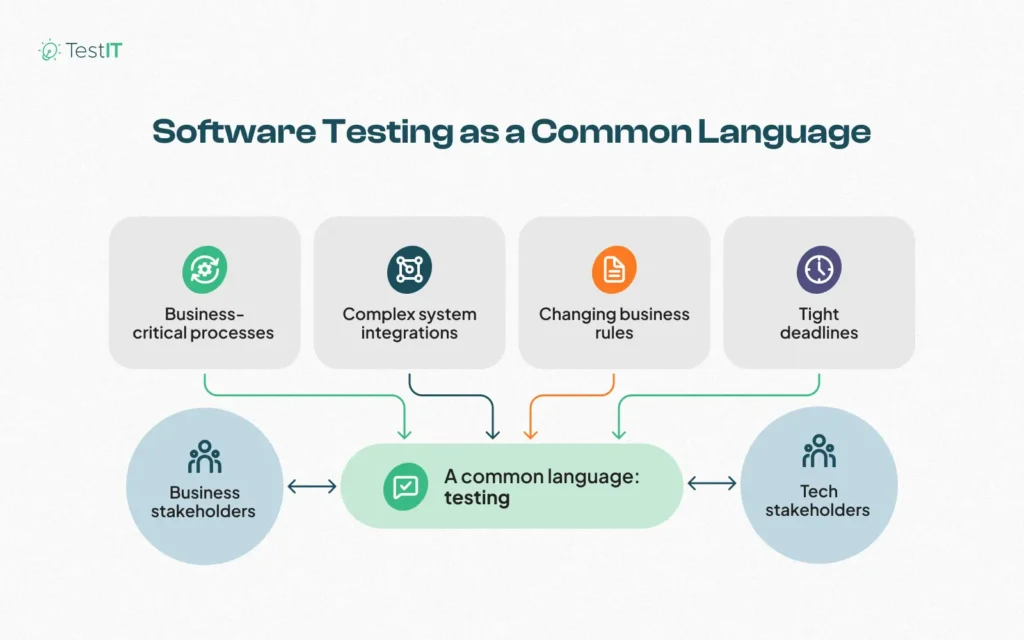
In practice, however, the reality is different. This is especially true when an organization must simultaneously manage business-critical processes, complex system interfaces, changing business rules, and tight deadlines. In such situations, testing can be much more than a subsequent control phase. For example, it can become a shared working process that clarifies expected behavior, aligns the involved domains, and makes a tangible contribution to project quality.
Through the example of an energy market project, we demonstrate how testing can become a genuine engine of quality. Here, the objective was not to rescue a poorly functioning project, but to build a system that would remain operable in the long term. By working in close collaboration, the client’s and vendor’s experts developed a more stable and better-documented solution in a structured manner and along clear business considerations.
The key lesson extends beyond this single project: testing can indeed become an engine of quality, rather than merely serving as its controller in a follow-up role.
Why Was This Project Strategically Important for Our Client?
In the energy market environment, the billing process is a business-critical component. The accuracy of settlement, the proper handling of tariff structures, the reliability of system interfaces, and reporting capability are all of simultaneous financial, operational, and reputational significance.
In this project, the objective was to validate a new billing logic and the related system processes. What made the task particularly distinctive was that it had to simultaneously:
- map new business rules
- preserve the operation of existing systems
- and execute all this in such a way that live operations remain
- and execute all this in such a way that live operations remain uninterrupted
Test coordination of a CRM system in the energy market.

Test Management and Manual Testing Services in the Energy Sector
Manual Testing, Test Management
How Did We Achieve Better Project Execution and What Was Our Role in This?
On the client side, this was accompanied by strong professional involvement: project management, systems analysis, and business stakeholders continuously participated in clarification and validation. This was crucial, because in such a complex environment success is never exclusively a technological issue. Real results emerge where business intent, system logic, and quality assurance discipline converge.
One natural characteristic of the project was that testing initially had to rely, in many cases, on partial information and continuous coordination. This is a common phenomenon in transformation projects where multiple systems, multiple areas of responsibility, and multiple layers of business rules are interconnected.
We moved beyond this by openly signalling uncertainties already in the daily meetings, involving the appropriate experts, and gradually transforming the identified behaviors into test cases and the detected deviations into clearly traceable defect tickets. This was the working method from which not only better testing, but also better collaborative project execution, emerged.
Our Approach: Laying a Common Foundation
During the project, the task of testing did not end with the verification of functions. The real added value was that testing became a kind of shared structuring layer between business and technology stakeholders. This is precisely the mindset with which we enter every project: we focus not only on how testing can be performed in the most efficient way, but also make recommendations on how operational processes can be built up - or, where necessary, disentangled and reorganized into a coherent system.
This is how we approached the task described above:
1. End-to-End Thinking from the Very First Moment
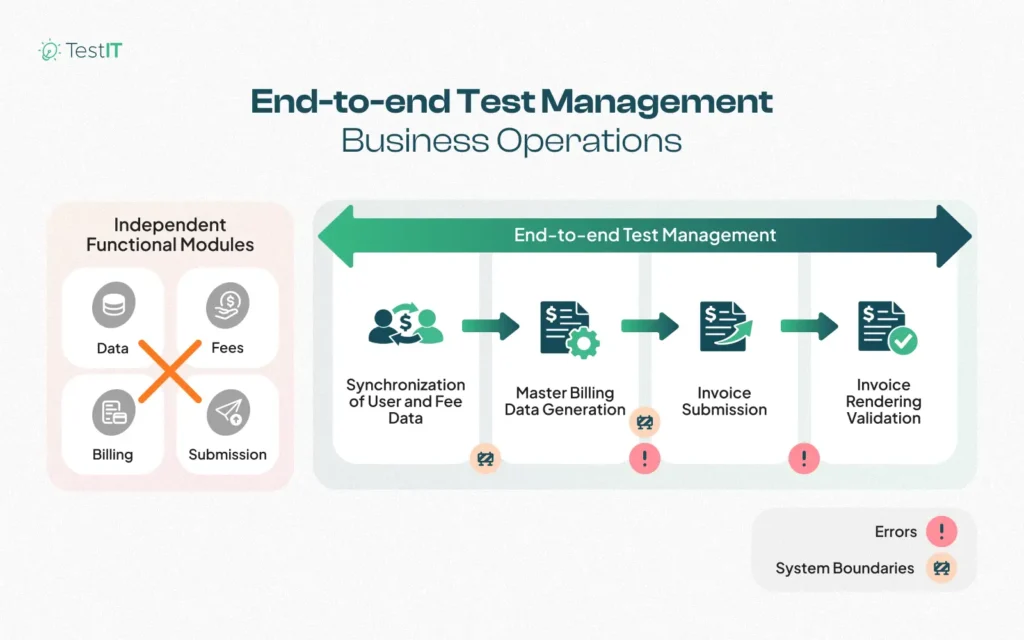
Rather than examining only isolated functional elements, we approached the entire billing process through an end-to-end logic. This meant that, from the synchronization of partner and tariff data, through the generation of billing master data, processing, invoice submission, and the verification of invoice output, we took the complete business operation as the basis of testing. This perspective is particularly important in enterprise projects where defects do not arise within a single function, but at the boundaries between systems.
2. From Gradual Discovery to a Structured Test Basis
As the project progressed, the operational behaviours refined jointly with the client-side experts were translated into concrete test cases. The input–output-based approach helped ensure that all stakeholders were answering the same question: what is the initial data set, through what process does it pass, and what is the expected result. This seemingly simple logic often makes the decisive difference between “opinions” and “genuine verifiability.”
3. Test Management, That Truly Supports Delivery
In this project, test coordination was not an administrative auxiliary function, but one of the key enablers of delivery stability. The handling of priorities, the tracking of open issues, the structuring of defect tickets, the scheduling of re-testing, and the continuous coordination of communication among stakeholders all contributed to preserving the project’s transparency.
4. Load and Performance Testing Aligned with Real Operational Logic
Through the use of JMeter, we did not merely conduct technical performance tests; we also validated data and load scenarios aligned with high-volume billing operations. This was important because, in a business environment, it is not sufficient for a system to function well in a single process step - it must also remain stable under real production load.
The Greatest Challenges and the Solutions Developed Jointly
✔ Complex Business Rules, Multiple Systems, One Shared Objective
One of the greatest challenges of the project was that multiple systems and multiple business logics intersected. In such situations, the key to success is not a “flawless initial state,” but whether there is an operating framework within which participants can clarify deviations quickly and accurately.
Here, the high level of professional involvement on the client side proved highly valuable. Project stakeholders did not merely answer questions; they actively contributed to ensuring that the operational logics could be formalized in a clear and unambiguous way.
✔ Iterative Refinement Where Uncertainty Exists
From an external perspective, many are inclined to view continuous coordination critically. We believe that in a complex transformation project, this is rather a sign of mature collaboration. This was the case here as well: the interpretation, refinement, and gradual transformation of operational logic into test cases did not hinder the project - on the contrary, it laid the foundation for a stable go-live.
✔ Testing as a Common Language
As the project progressed, the test cases and well-structured defect tickets became a shared point of reference. This is particularly valuable in environments where development, business, and project stakeholders work together. Here, testing provided not only control, but also a common language.
Project Outcomes
Alongside the business and operational results that emerged first, the longer-term organisational outcomes are at least equally important.
✔ Safer Billing Implementation
The new tariff structure and the related processes were deployed to production on the basis of validated results.
✔ Reduced Need for Manual Corrections
Thanks to end-to-end testing, a significant share of deviations could be identified and addressed before live operation.
✔ Greater Transparency Across the Entire Process
The test cases and defect tickets clearly showed what was functioning properly, where further refinement was required, and what required decision-making.
More Predictable Operations
The validation of synchronization between systems and of the billing logic supported more stable day-to-day operations.
✔ More Formalised Operational Knowledge
The logics documented during testing constituted a reusable knowledge base.
✔ Stronger Business–IT Collaboration
The shared validation and coordination activities not only advanced the project, but also improved the quality of collaboration.
✔ More Sustainably Manageable Processes
The documented and validated operational model provides a stable foundation for future modifications as well.
Lessons Learned
There are certain points that stakeholders in similar projects should consider before embarking on the initiative.
1. Early Involvement of Testing Yields Real Returns
The earlier testing becomes an integral part of the project, the more effectively it can not only identify defects, but also provide structure to the operation itself.
2. Detailed Documentation Does Not Slow Things Down; It Accelerates Them
In this project, preparing detailed and comprehensive test documentation took far less time than the amount of time the client saved by avoiding effort lost to change requests and specification deficiencies.
3. Testing Does Not Serve Only a Downstream Role
In this project, in close cooperation with the business, we were able to apply a test-driven approach focused on delivering a working solution.
4. A Good Partner Does Not Merely Provide Capacity
In complex projects, external expert support is truly valuable when it provides not only people, but also methodological discipline, structured thinking, and a level of transparency that is useful from a managerial perspective as well.
How to Handle Similar Projects?
When multiple systems, multiple stakeholder areas, and business-critical operations intersect, this is precisely when an external partner such as TestIT can be the right choice.
If you choose us, we bring genuine expertise and capabilities to any similar project in these three areas:
- Strategy-to-Execution Management: test management and methodological support from strategy design through implementation to operations
- Testing as a Service (TaaS): end-to-end testing support with manual and automated elements, test coordination, test data management, and stable BAU support
- AI-Driven Testing: AI-supported testing processes with distinct deliverables that are interpretable from a business perspective
If you are currently facing an implementation, migration, or process transformation, it is worth discussing quality assurance aspects before testing turns into urgent, retrospective firefighting.
FAQ
1. How Can Testing Be Done Effectively If Not All Information Is Available at the Beginning of the Project?
In complex enterprise projects, this is a common situation. In such cases, the right approach is not to wait, but to proceed through iterative discovery. By progressively refining operational logic, conducting daily alignments, involving business experts, and creating structured test cases, uncertainty can be managed effectively. This requires strong test management, sensitivity to business processes, and strong communication skills.
2. What Tools Help in a Project Like This?
In this project, SPIRA supported the structured tracking of test cases, executions, and defects, while JMeter added value in load and performance testing. Most importantly, however, it is not the tool itself that matters, but whether it supports transparency, reproducibility, and rapid decision-making.
3. When Does Detailed Test Documentation Pay Off?
Usually much sooner than organisations initially assume. This is especially true when multiple stakeholders, multiple systems, and complex business rules are involved. Detailed documentation reduces duplicated effort caused by misunderstandings, shortens clarification cycles, and also provides a stable foundation for future changes.