English (UK)
  Magyar
  Deutsch
 Which software testing tools should organizations choose in an SME or enterprise environment? This practical guide compares tools and technologies used for test automation, test management, performance testing, and AI-driven testing.
Drawing on 10 years of hands-on testing experience, we outline the key criteria for selecting testing tools, explain which currently available technologies we recommend for specific purposes, and clarify which expectations are realistic-and which are not-when evaluating today’s solutions.
TL;DR / Short Summary
- There is no universal answer to the question of which testing tool is the best.
- The decisive factor is what you want to use the tool for, in what environment, and with what kind of team.
- In web/UI automation, Selenium remains the market leader, but Playwright has already taken the lead in many newly launched projects.
- For API testing, Rest Assured, Postman/Newman, and in certain cases Playwright’s API capabilities are all effective choices.
- In mobile testing, Appium continues to be the most reliable enterprise-grade option.
- In the performance domain, JMeter is the established classic, while k6 represents a modern, CI/CD-ready direction.
- For test management, Jira Xray, TestRail, and Zephyr are all strong options.
- AI can improve efficiency, but it will not fix poor specifications, incomplete documentation, or a weak test strategy.
Table of Contents
1. What Is the Real Question When Selecting a Tool?
When selecting a testing tool, teams often make decisions based on the wrong criteria. Such an early mistake can become very costly for a company-not only financially, but also in terms of long-term technological consequences. Although every project has its own dynamics, one thing can generally be said: once automation reaches critical mass and testing becomes more complex, one or more of the following structural problems tends to surface relatively quickly:
- Framework maintenance begins to consume a disproportionate amount of time - often not because of the tool itself, but because of a lack of deliberate planning and the absence of appropriate design patterns.
- It becomes apparent that the team lacks the technical expertise required both for using the tool effectively and for writing maintainable automation code.
- The solution cannot be integrated seamlessly into the existing CI/CD pipeline.
- Reporting fails to provide meaningful and transparent insight for management.
- A weak or incomplete test strategy undermines ROI, because the team insists on automating test cases that should never have been prioritized for automation from a business perspective in the first place.
To make the right tool selection, it is worth asking the following questions:
- What kind of system are we trying to automate?
- How complex is the environment?
- How much release pressure are we operating under?
- What in-house knowledge and capabilities can we rely on?
- How important are auditability, scalability, and long-term maintainability?
The key takeaway is this: selecting the “perfect” tool for the task is only the very first step. Even the best framework will fail in practice if the fundamentals are missing-namely a stable test architecture, solid engineering principles, and implementation aligned with industry standards.
Just as importantly, the tool should not be the starting point; the problem should be. That is why, at TestIT, we work with a technology-independent, tool-agnostic mindset. We are neither official representatives of, nor dogmatic advocates for, any specific solution.
2. What criteria should guide the selection of a software testing tool?
1. The technology stack of the system to be automated
This is often the single most effective factor in narrowing down the field. The optimal choice is not the same when testing, for example, a modern web frontend, a complex API layer, a native mobile application, a desktop system, or an enterprise platform such as SAP, Salesforce, or ServiceNow.
EXAMPLES:
In the case of Salesforce, the complex HTML structure and the Shadow DOM can make automation technically far more sensitive. It is not enough to consider whether a tool “can click”; it is equally important to assess how sustainably it supports locator strategy management in the long term.
If Desktop E2E automated testing is unavoidable, many testing tools fail right at the outset.
2. The existing toolset and internal competence
This is typically one of the most underestimated factors. Yet if, for example, Java is the standard automation language on the client side, a Selenium and REST API test automation stack is already in place, Azure DevOps is being used, and JIRA/Xray serves as the test management tool, then it makes sense to align with that existing ecosystem.
EXAMPLE:
If everyone works in Java, it may not make sense to move the solution to Python, even if that would be technically feasible. Choosing the right tool is not only a technological decision, but also a question of knowledge transfer and long-term maintainability.
3. The scope of the task and the return on investment
There are 3 rules of thumb here.
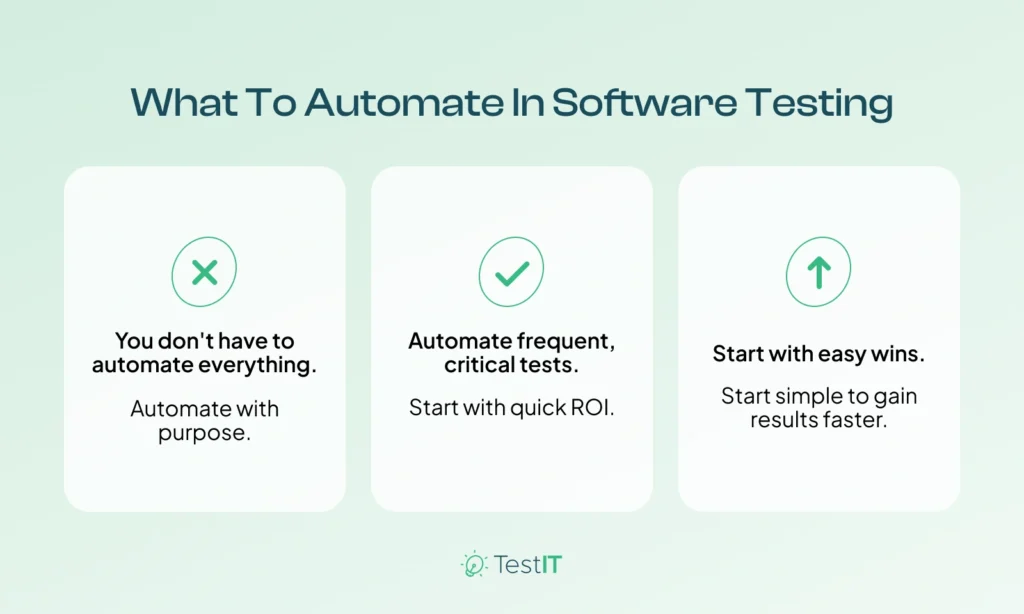
1. Not everything should be automated.
This point does not always receive the attention it deserves, even though it is often a decisive consideration.
2. If it is frequent, critical, repetitive, and delivers fast ROI - automate it.
At TestIT, we generally recommend starting with test cases that run frequently, are business-critical, can be repeated in a stable way, and promise a quick return on investment.
3. Start with the low-hanging fruit.
Build on the Pareto principle (the 80/20 rule): in many cases, the most complex 20% of automation targets consume 80% of the effort and resources. That is why it makes sense to start with the low-hanging fruit. This is not only more cost-effective, but also helps increase internal acceptance of automation initiatives.
4. Costs and licensing
An open-source solution is not automatically the cheaper option. Licensing is only one cost item among many. If you choose such a solution, it is essential to consider everything that contributes to the total cost of ownership.
These typically include:
1. Building the framework
2. Selecting test cases and converting them into the appropriate format
3. Setting up permissions and technical users
4. Automating the test cases
5. Designing suitable reporting
6. Integrating automated execution and report analysis into the testing process
7. Maintenance
8. Upskilling the team to use the tool effectively
9. Review and governance
10. CI/CD integration
11. Data protection compliance
This is especially true for packaged solutions enhanced with AI capabilities as well: at first glance, they may appear fast and convenient, but they can introduce too many layers of abstraction, making them insufficiently flexible in practice.
5. Sustainability and maintainability
This is where most plans ultimately fail. A tool may perform well in a pilot phase, but without a solid framework structure, consistent design patterns, coding conventions, review discipline, and a business-aligned scope, long-term maintenance can become more expensive than the original implementation.
3. Which tools are stable choices, and which are emerging solutions?
A testing tool should never be selected simply because it is currently the most hyped option. At the same time, it is worth understanding which tools have long been stable and reliable, and in what areas the newer market entrants offer additional value or outperform their predecessors. Below is a brief overview.
| Category | Stable, proven tools | Emerging / modern tools |
| Web/UI automation | Selenium An industry standard since around 2008. | Cypress Saw strong growth roughly between 2018 and 2023. Playwright |
| API testing | Rest Assured, Postman/Newman Stable, classic tools. | Playwright API Its key advantage is that it forms a unified framework together with Playwright’s UI capabilities. Insomnia |
| Mobile automation | Appium A leading solution since 2014. While usage patterns have evolved, there is still no truly stable cross-platform alternative for Android and iOS. | Maestro An extremely fast, agile, and emerging challenger. However, due to the lack of physical device and device farm support, its enterprise-level applicability is currently limited. |
| Performance testing | JMeter A long-established standard tool.
NeoLoad | k6 Has become significantly more popular in recent years, especially in modern CI/CD environments. |
| Test management | Jira Xray, TestRail, Zephyr Well-established, durable tools. | – |
| Codeless / packaged solutions | Tosca A long-standing key player in enterprise environments.
Ranorex | AI-driven no-code solutions Have been gaining momentum since 2024, but still require careful filtering and evaluation. |
4. Which tool works well in which environment?
1. Web & UI testing / end-to-end automation
Selenium
This remains the classic, unavoidable tool that has proven itself in enterprise environments for many years. It has its drawbacks, but a significant number of large-scale corporate automation stacks are still built on it.

Playwright
Playwright can be an excellent choice because it can be used for both Web/UI and API testing, allowing prerequisites, test data, and post-processing steps to be handled within a single framework. In addition, it can significantly speed up test execution and help reduce flakiness.

Cypress
Cypress is also frequently considered, but at TestIT we see it as particularly strong for specific use cases rather than as a universal enterprise-grade E2E solution.
Which testing tool do we recommend for Web/UI testing across enterprise applications?
Application / platform | Recommended tool | Why do experts often recommend them? |
Salesforce | Primarily Playwright, optionally Selenium (for existing projects). | Because of fast-running UI tests, dynamic waits, and a lower flakiness rate, Playwright is the more suitable option. |
ServiceNow | Primarily Playwright, optionally Selenium (for existing projects).
| For newly launched projects, Playwright, with its more modern architecture, is generally the better choice.
|
SAP Fiori / SAP S/4 HANA | Tosca or Playwright | In SAP environments, Tosca is a good option in many cases, although it is quite costly. Web-based SAP can also be automated effectively with Playwright. |
Microsoft Dynamics 365 | Playwright or Tosca | In this case as well, Playwright stands its ground as a free alternative. Tosca is a practical, but costly solution. |
2. API testing tools
In API testing, the Java-based Rest Assured remains a stable choice. Postman is highly useful for quick manual validation, while Newman fits well into CLI-based and CI/CD-driven execution. In Python-based environments, solutions built on Pytest + Requests can serve a similar role.

Postman is a practical and easy-to-use tool: it can be adopted quickly, and thanks to Newman, it can also be automated. One of its key advantages is that collections originally created for manual testing can be converted into automated tests with relatively little additional effort.

EXAMPLE:
We have seen this in our own projects as well. In the testing of a banking credit decision engine, for instance, defining an API testing methodology and introducing tools such as Postman or Insomnia not only accelerated validation, but also resulted in a more stable overall testing operation.
Which testing tool do we recommend for API testing across enterprise applications?
The recommended tools are generally independent of the specific application. Far more important are the existing technology stack and the team’s competencies.
EXAMPLE:
- If developers or manual testers are already using Postman, it is worth building the test automation on the existing collections, and with the help of Newman, the tests can also be executed in CI/CD).
- If the UI tests have been written in Playwright, the API tests can also be implemented within the same project using Playwright.
- In the case of an existing Java/Selenium stack, Rest Assured may be the optimal choice.
3. Mobile Testing Tools
In mobile automation, we currently do not see a better, generally applicable enterprise alternative on the market than Appium.
Appium
The advantage of Appium is that it can be used for both iOS and Android. In practice, its usage is not always as simple as marketing materials suggest, but from a cross-platform perspective, it is still the most stable tool available today.
It may be recommended, for example, for:
- banking mobile apps
- ServiceNow Mobile processes
- Salesforce Field Service mobile workflows
- logistics and field service apps
Professionals mainly like it because it can be integrated with many frameworks and languages, and it works predictably, which is especially important in enterprise environments.

Maestro
One of the most dynamically evolving declarative (YAML-based) tools of recent years, offering an outstanding developer experience (DX) and a low barrier to entry. Although its speed in test writing and execution is compelling, it still clearly falls short of Appium’s mature ecosystem when it comes to complex enterprise CI/CD integration and support for cloud-based device farms.
4. Performance & Load Testing Tools
Jmeter
JMeter is the robust, open-source classic of performance testing. Thanks to its broad protocol support, it is still absolutely dominant in complex enterprise environments that combine legacy and modern architectures. Although its GUI-driven and XML-based structure makes it less developer-friendly, it often remains the most justified choice for large-scale load tests spanning multiple technology layers.
k6
k6 is the frontrunner of the modern, developer-centric "performance-as-code" approach. Thanks to its JavaScript-based, lightweight architecture, it fits naturally and seamlessly into CI/CD pipelines. Its outstanding architectural advantage is reusability: API calls can be invoked from a shared codebase, drastically reducing the burden of parallel maintenance. This is a critical factor in agile operations, even if JMeter remains unavoidable for certain enterprise integrations.

Which tools do we recommend for performance and load testing?
Application area | Recommended tool | Why? |
Complex banking system with legacy systems | JMeter | Open-source and supports a wide range of different protocols, and can be considered an industry standard.
A proven tool for complex load patterns (it was also an effective tool in our own experience in the energy sector). |
REST API load testing, modern web application and mobile app | k6 | Fits into modern architectures, JavaScript/TypeScript-based, CI/CD-friendly. |
SAP | LoadRunner | Stable, versatile enterprise solution. |
Enterprise testing team | NeoLoad / LoadRunner | Paid solutions, but they may offer more mature enterprise functionality. |
5. Test management tools
Many large enterprises underestimate the importance of selecting the right test management tool, even though in ERP, CRM, or banking environments, this is often what provides real transparency.
We also know from our own projects how crucial this is. For example, in a banking credit assessment team, the introduction of Jira Xray was the foundation of the new team’s way of working. In a billing and integration project in the energy sector, SpiraTeam helped ensure the structured tracking of test cases, executions, and defects.
The most commonly used test management tools are: Jira Xray, TestRail, Zephyr, Spira.

AI-driven testing - What should we pay attention to?
At TestIT, we are currently also using tools such as GitHub Copilot and Claude Code on an experimental basis, with an agentic approach. This means that AI is gaining increasing visibility into the project: the code, the test cases, the environment, and later even the design.

It is important to understand both sides of the coin: the advantages as well as the disadvantages.
Advantages of AI-driven testing | Disadvantages of AI-driven testing |
|
It can only work from high-quality test documentation (this is also true for all other forms of AI-driven automation).
|

What we do not believe in:
- vibe coding when AI is being used to compensate for a lack of competence
- solutions used without appropriate data protection and corporate security frameworks
- large projects built on very new open-source directions with an uncertain future
- AI solutions that are too narrowly tailored to a specific task (AI solutions closer to the code are better)
What practice shows:
- Documentation quality is critical - AI can only work from what has been written down. If the specification, test documentation, user stories, requirements, or test strategy are not in order, AI cannot work miracles either.
- There is a lot of hype, but we are still experimenting - Although AI-driven testing solutions are spreading dynamically, and based on testing forums it may seem as if everyone is already using them, our experience is that in practice this is still more of an experimental field for the time being.
What do we recommend in practice, based on 10+ years of testing expertise?
The 3 most important aspects
 The application and the environment to be tested should be the deciding factor, not the current trend. Take existing competencies and the tool environment into account. Keep sustainability, maintainability, and return on investment in focus.
Based on these, we are much more likely to make a good decision.
Generally, a good solution may be:
- in the case of a large existing automated test suite: Selenium
- for new, greenfield automation: Playwright
- for a Java stack: Rest Assured
- for a Python stack: Pytest + Requests library
- alongside Playwright UI tests: Playwright API tests
- as a developer-friendly solution: Postman/Newman
- for performance: JMeter or k6
- for test management: Xray, TestRail, Zephyr depending on the environment
The importance of expertise
Expertise still cannot be spared when selecting software testing tools. Especially in the case of AI tools, good specifications, clear use cases, a well-thought-out test strategy, and, if necessary, strategic revision are required. A tool can be selected quickly. Making a good decision, however, is rarely possible without testing expertise.
About us briefly
TestIT provides expert support in testing enterprise-scale, complex, and business-critical projects. Our strength lies not only in our broad tool knowledge, but also in our ability to quickly build a transparent, effective testing structure even when documentation is incomplete, there are many stakeholders, and operating conditions are changing. From planning and methodology through coordination to execution, we support the entire process so that our clients can work with more stable releases, lower risk, and better decision support.
FAQ
What tools are used for software testing?
Software testing tools can be divided into several categories. These include web/UI automation tools (such as Selenium, Playwright, and Cypress), API testing tools (such as Rest Assured, Postman, Newman, and Insomnia), mobile testing tools (such as Appium), performance testing tools (such as JMeter, k6, LoadRunner, and NeoLoad), as well as test management tools (such as Jira Xray, TestRail, or Zephyr).
What are the most popular test automation tools?
The most popular test automation tools currently are Selenium, Playwright, Cypress, and Appium. In enterprise environments, Selenium is still very strong because it has long been a proven and stable tool. In modern web automation, Playwright has started to gain strong momentum in recent years. In mobile automation, Appium also remains one of the most stable choices.
What are the best test management tools for ERP implementations?
For ERP implementations, the most common test management tools are Jira Xray, TestRail, Zephyr, and Spira. In the case of SAP S/4HANA, Oracle ERP, or Microsoft Dynamics 365, these are good choices because they help track requirements, test cases, defects, and releases, which is also crucial from an auditability and enterprise transparency perspective.
Does Playwright support mobile testing?
Playwright supports testing related to mobile views, such as device emulation and mobile browser-based web use cases. However, it is not the primary enterprise choice for automated testing of native iOS and Android applications. For that, professionals still tend to recommend Appium.
What are API testing tools?
API testing tools are tools used to test backend services, integrations, and business logic without a UI or independently of the UI. The best-known API testing tools are Postman, Newman, Rest Assured, Insomnia, and, for certain use cases, the Playwright API module. These are particularly useful, for example, when testing ServiceNow, Salesforce, SAP APIs, MuleSoft, or credit assessment systems.